Thursday, 9 April 2015

What Do We Do Daytime?

CULTUREthe ideas, customs, and social behaviour of a particular people or society”

The cultural melting pot can be examined deeper through various entertainment and recreation available within the city. Culture can be considered what people do and it definitely contributes to the culture of an urban space. Port of Spain is the hub of entertainment and recreation, since it is the capital city.  Jane Jacobs believes that the city allows fir accessible public spaces that can be used for recreation. Port of Spain is a perfect example of this with the public space being used for various recreational purposes.

The first photo shows individuals using the Queen’s Park Savannah for exercising. This Savannah is used by many locals for healthy living. It gives people the ability to exercise with others without being segregated. It is available for everyone. The Queen’s Park Savannah is most frequently used around the Carnival period with many sponsored aerobics classes.  It is not only used for running but also for various sports like football and cricket.  Also on Easter Monday, a grand kite flying contest is held at the Queen’s park Savannah. This may indeed be a part of Port of Spain’s culture.
Individuals exercising around the Queen's Park Savannah
The second photo displays a major shopping center on Charlotte Street, Port of Spain. The picture portrays a more traditional style building reflecting on the original culture of Trinidad and Tobago. Charlotte Street is one of the main street for shopping. This street is usually congested around Christmas time with space to even breathe. Shopping is important in any culture and Charlotte Street will forever be a part of Trinidad and Tobago’s shopping recreational culture.
Charlotte Street, Port of Spain, Trinidad
This third photo depicts elderly individuals relaxing along the Brian Lara Promenade. This public space is usually used by the senior citizens in society. On entering the promenade you can hear the chatter amongst them or some quarrelling about their chess match. It’s a nostalgic feeling when seeing the senior citizen portraying traditional culture in today’s society.
Citizens relax along the Brian Lara Promenade
Citizen enjoy daytime entertainment and recreation. However, there may be some issues within Port of Spain that may encourage individuals to turn away. The Queen’s Park Savannah has been deteriorating, according to Richie Gaspard, Trinidad Express. He claims that, “Vagrants are seen sleeping on the park benches and under the large trees. Careful about sitting under some of those trees because they have fresh faeces under them.” This can be a major turn off for most people. Other places that are rampant with vagrants are Charlotte Street and the Brian Lara Promenade. This situations turn people away from socializing in these areas. 


References:
Trinidad Express Newspapers (2015 ) “Free-for-all deterioration of the Queens Park Savanna”.  Retrieved on March 3rd, 2015 from http://www.trinidadexpress.com/letters/Free-for-all-deterioration-at-the-Queens-Park-Savannah-236130651.html

Tuesday, 7 April 2015

Nighttime Melting Pot

The city at night is also a melting pot as it attracts residents, friends, lovers, co- workers, students, acquaintances and tourists (Grazian, 2009). As in the day, people come to the city to access the goods and services that it offers during the night. During the Carnival season, the urban nights are filled with events just as the day creating opportunities that illustrate the diversity of its people.  These events all incorporate elements of the rich Trinidadian culture thus encouraging an increase in diversity, acceptance and equity.
The first photo shows the coming together of people at an event that they all had a common interest in despite their difference. At all of these events the audience is never people from one culture or one segment of society. It is always mixed and facilitates interaction between the locals and the tourists. The first photo was taken at Fatima Fete and just one example of an event that brought people from different cultures together.
Fatima Fete 2015
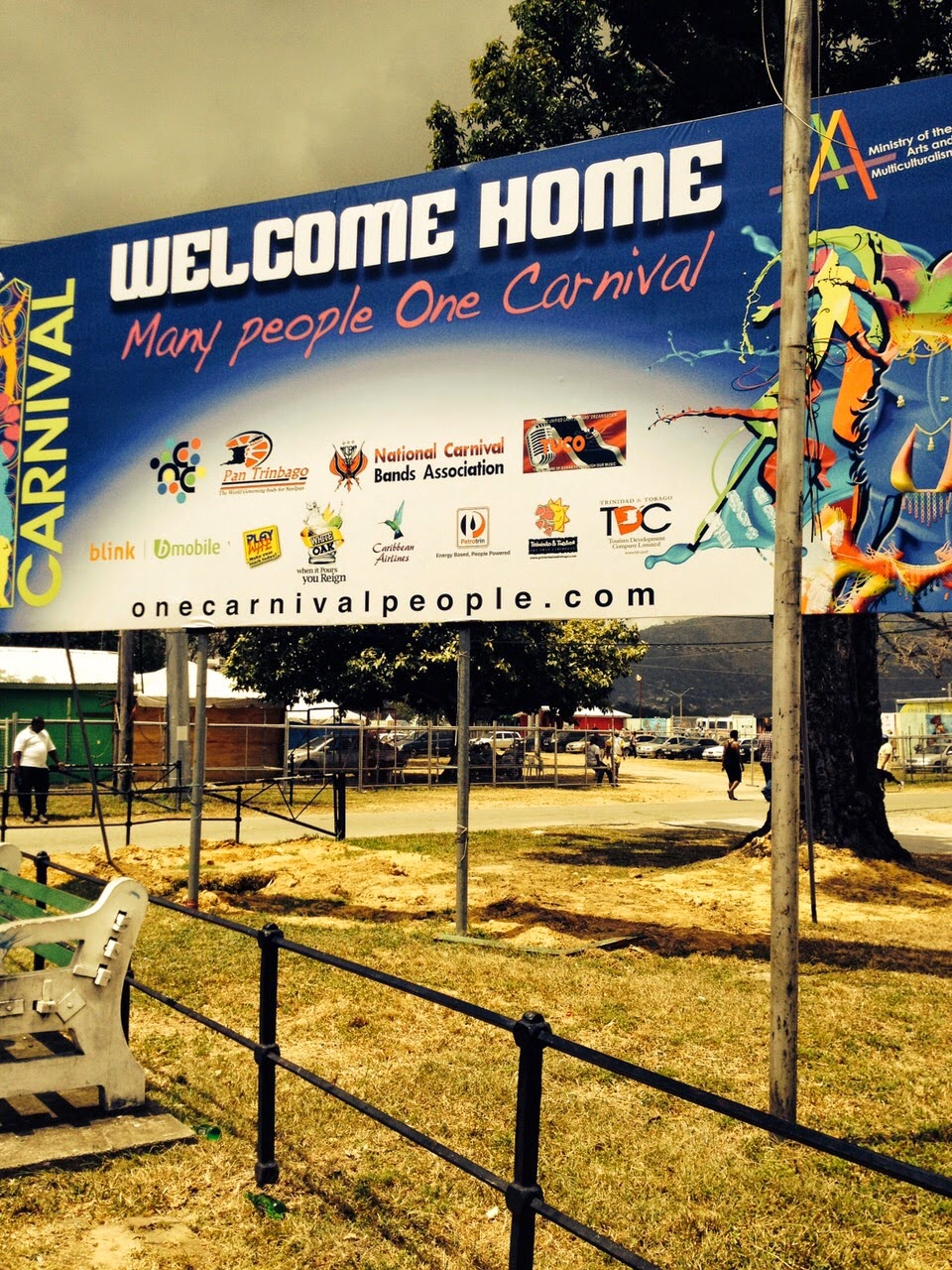
The second and third photo was taken at Carnival Village. In an effort to promote and sustain Trinidad’s culture, the Government of Trinidad and Tobago in 2011 organised a Carnival Village (Trinidad Express Newspapers, 2011). Placed in the center of the city, the Queen’s Park Savannah, it aims to showcase our culture and provide information about it. During the day as well as the night there are many booths displaying carnival costumes, providing booklets for people to read, and displaying other artifacts that has contributed to Trinidad and Tobago’s culture. 
Side entrance to Carnival Village
Placed in the center of the city, the Queen’s Park Savannah, it aims to showcase our culture and provide information about it. During the day as well as the night there are many booths displaying carnival costumes, providing booklets for people to read, and displaying other artifacts that has contributed to Trinidad and Tobago’s culture. The photos show an event held in the night promoting local entertainment associated with Carnival. This Carnival Village has served as a melting pot not only because it showcases the different cultures in Trinidad but because it also brings together different people in one spot!
Display in Carnival Village
Trinidad and Tobago, the home of Carnival, the ‘greatest show on Earth’, has bypassed many Caribbean countries in the way it promotes and develops its culture. This is mainly as a result of its economy which allows for significant figures to be used to fund these events and shows. Other countries in the Caribbean do not experience this, at least not to this extent. However, since the Caribbean has a shared history, a lot of what is displayed can be linked to the other Caribbean islands as well.

References:
Grazian, David (2009) Urban Nightlife, Social Capital, and the Public Life of Cities. Sociological Forum 24.4, 908-917. Accessed March 2nd, 2015 from http://works.bepress.com/david_grazian/11
Trinidad Express Newspapers (2015) “Carnival Village opens today.”  Retrieved on March 3rd, 2015 from http://www.trinidadexpress.com/news/Carnival-Village-opens-today-289747581.html

Friday, 6 February 2015

The Melting Pot


The city is defined as a place where diffused rays of many separate beams of life fall into focus (Mumford 1938). These diffused rays of separate life influences the practices that take place in the city and which contribute to the material culture of the urban area. This culture is highly diversified creating what is known as a ‘melting pot’.


The Caribbean is well known for its diversity and unique culture. Trinidad and Tobago has always been known as a melting pot. This is a result of its rich history which allowed for descendants from all over the world but largely, Asia, Africa and Europe. However, in its city of Port of Spain, the melting pot is seen as much more than just different ethnicities. It refers to the profound diversity of the city, its people, its culture, its society, economics and politics. For our capital city, there is no better way to highlight this urban melting pot than through its Carnival celebrations.
Traditional 'Ole Mas' - Port of Spain, Trinidad
The first photo illustrates young children parading through the streets of Port of Spain playing traditional ‘ole mas’ characterised by their ‘Moko Jumbie’ costumes. The earliest Carnivals in the city of Port of Spain were an event where the emancipated former African slaves took to the streets to celebrate. The ‘Moko Jumbie’ was one of the main costumes used. Its name was derived from a God named ‘Moko’ of the West African tradition. The outfit entailed people walking on stilts and wearing bright coloured clothing (Nalis, 2012). However, these traditional costumes are no longer the main attire used for Carnival celebrations. Much is being done to keep the traditional ‘Ole Mas’ alive.
The photo then can show a deeper meaning of children of different backgrounds coming together to celebrate their history as Trinidadians. In addition, they are either knowingly or unknowingly trying to preserve the traditional mas and what it represents. That is, the freedom, courage and endurance of the former slaves.  
Carnival gathering at the Queen's Park Savanna, Port of Spain
The second photo captures numerous people at the Kiddies Carnival celebrations located on the Queen’s Park Savannah. As the country gets ready to celebrate its two days of revelry, colour, glam and rhythm, the nations’ children can extend their Carnival celebrations by taking part in ‘Kiddies’ parades, shows and competition. This affair serves to bring together tourists, Trinidadians and more importantly the children of the nation in an eventful array of Junior Carnival celebrations.
Carnival stall along the Queen's Park Savanna with  cultural items
The third photo depicts several stalls along the Queen’s Park Savannah that sells cultural items. These stalls sell a variety of cultural items representative of the many cultures within Trinidad and Tobago and the wider Caribbean. The items are not only available for Trinidadians but to tourists as well, so they can take a piece of the Caribbean home.

This melting pot effect that is vibrant and prominent in the daytime of the urban city of Port of Spain is not only limited to Trinidad alone. Throughout the Caribbean, our similar history has granted us descendants from throughout the world. The same concentration of people, culture, society, economics and politics in urban areas give distinctly diverse cities. Cities throughout the Caribbean then will more than likely experience similar cultural fusion as Port of Spain, Trinidad.


With Carnival, one of the current issues that scorch the land is the risk of the Ebola disease entering our borders with the influx of tourists for the event. The country is ever vigilant and the authorities are taking the necessary precautions to prevent this. The deadly Ebola disease could hardly ever stop the celebrations of not just Carnival but the coming together as one despite the differences.

References:
CCNTV6 (2014) Retrieved on March 3rd, 2015 from http://www.tv6tnt.com/sevenpm-news/-CARNIVAL-WILL-GO-ON-AS-PLAN-280874622.html
 Mumford, Lewis.1938. The Culture of Cities. New York: Harcourt, Brace and Company. Accessed February 3, 2015 from http://myelearning.sta.uwi.edu/file.php/25346/Lewis_Mumford_Introduction_The_Culture_of_Cities_1938_xid-3429222_2.PDF

It's A Town Thing


With the Caribbean becoming more like "Little Americas", it is not foreign to witness activities that were traditional Global North culture. Trinidad especially, is no stranger to this. It's capital, Port of Spain, according to Caribbean Journal, is the most developed in the English speaking Caribbean and it shows through its nightlife. Popular places like the Queen's Park Savanna, Ariapita Avenue and St. James 'City That Never Sleeps", all contribute to the rich nightlife of Port of Spain. With famous clubs and bars for "liming", entertainment and all-night street foods, Port of Spain is an integral contributor to Trinidad and Tobago's culture.
Though, the nightlife seems crazy in a good way, daytime, Port of Spain is filled with locals and traffic. Busy with people heading to work, school, running errands and shopping, the streets of the CBD, Port of Spain is always lively. It is not bizarre to spot locals at bars "liming" or entertaining themselves from as early as 9am around Port of Spain. Its an insanely cool, relaxed lifestyle with plenty to see and plenty to do. 
This blog seeks to creatively explore the culture of the urban during the day and the night.